
Where Cyprus, Greece, and Germany stand and why the upward trend persists
The latest Eurostat report (April 9, 2026) confirms that social media engagement remains the cornerstone of digital life for young Europeans.
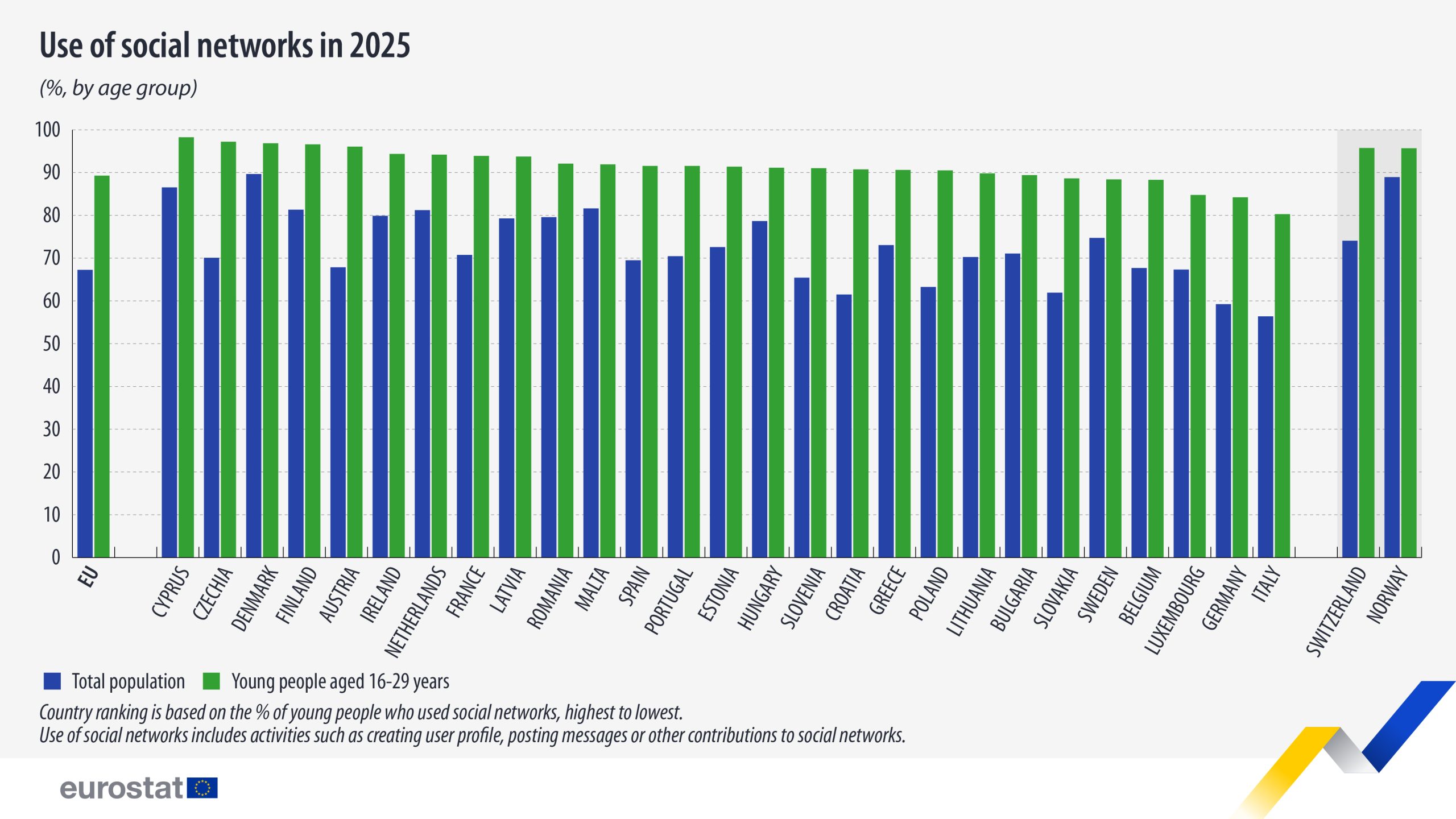
According to the report, during 2025, an impressive 89.3% of youth aged 16-29 across the European Union were active on social platforms. This figure significantly outpaces the general population average of 67.3%. In 19 of the 27 member states, participation rates now exceed 90%. Cyprus leads the European rankings with a staggering 98.3%, followed closely by the Czech Republic (97.2%), Denmark (96.9%), and Finland (96.6%). Conversely, while still high, the lowest youth percentages were recorded in Italy (80.3%), Germany (84.2%), and Luxembourg (84.8%).
Significant “digital gaps” persist when compared to the general population. The widest disparity was recorded in Croatia, with a 29.2 percentage point difference (90.7% for youth versus 61.5% overall). Large gaps were also noted in Austria (28.2 points) and Poland (27.2 points). In contrast, the most homogeneous digital landscapes were found in Denmark, where the difference is just 7.2 points, Malta (10.3 points), and Cyprus (11.8 points).
The figures highlight a diverse landscape across the markets where Novelty Media World operates, with Cyprus leading the entire EU. Specifically:
Cyprus: Cyprus dominates the European Union in youth participation. With 98.3% of young people active online, the island has essentially hit its peak. The narrow gap between youth and the general population (86.5%) suggests that social media has successfully permeated almost every age group.
Greece: While the EU general average sits at 67%, Greece maintains strong youth participation at 91.8%, aligning with the Mediterranean trend for high social connectivity. This puts the country above the European average (89.3%) and underscores the youth’s deep familiarity with digital platforms. However, the digital gap remains noticeable, as overall usage in the country stands at 73.6% – an 18.2-point difference.
Germany: Germany recorded one of the EU’s lowest youth usage rates at 84.2%. While high, this suggests a more fragmented media landscape or a stronger reliance on alternative communication channels. Germany also features one of the EU’s largest digital gaps, with a 21.5-point difference between youth and the general population (62.7%).
Why is social media use increasing among young people?
The surge in social media usage represents a profound shift in daily life. These platforms have evolved from simple communication tools into the primary fabric of existence. This steady rise across the EU can be attributed to four main factors:
- Social media is no longer just for entertainment. LinkedIn, X, and even TikTok are increasingly vital for professional networking and corporate communication. As public figures and institutions use these platforms as their primary Press Office, citizens of all ages must engage to stay informed.
- Young people are moving away from traditional search engines. They use TikTok and Instagram for everything from product reviews and study guides to medical advice and news. Information is visual, instant, and comes from trusted peers, making social media their primary knowledge source.
- As algorithms become more sophisticated, users receive content that is more relevant and engaging than ever. Feeds are now so precisely tailored to individual preferences that disengaging from the screen is increasingly difficult, driving up total time spent on these platforms.
- Transactions are now happening directly within apps. Young users discover products via influencers and purchase them with a single click without ever leaving the application. This transforms scrolling into a seamless, continuous consumer experience.
The data suggests that social media remains the domain of the youth, and that the “digital-first” generation is now transitioning into an exclusively “digital-only” reality.